Everyday maths at home can start with something your family is already doing: setting the table, planning a journey or sharing a snack. You do not need to turn these moments into a lesson. Choose an activity your child enjoys, invite them to explain an idea and adjust the task to what they are learning at school.
Count with a purpose
Ask your child to work out how many cups are needed for the people at the table. What changes if another person joins? For a child ready to explore grouping, arrange objects in pairs or equal rows and talk about the arrangement. Use quantities they can handle comfortably. If the task becomes frustrating, reduce the number of objects or work through an example together.
Compare and measure while cooking
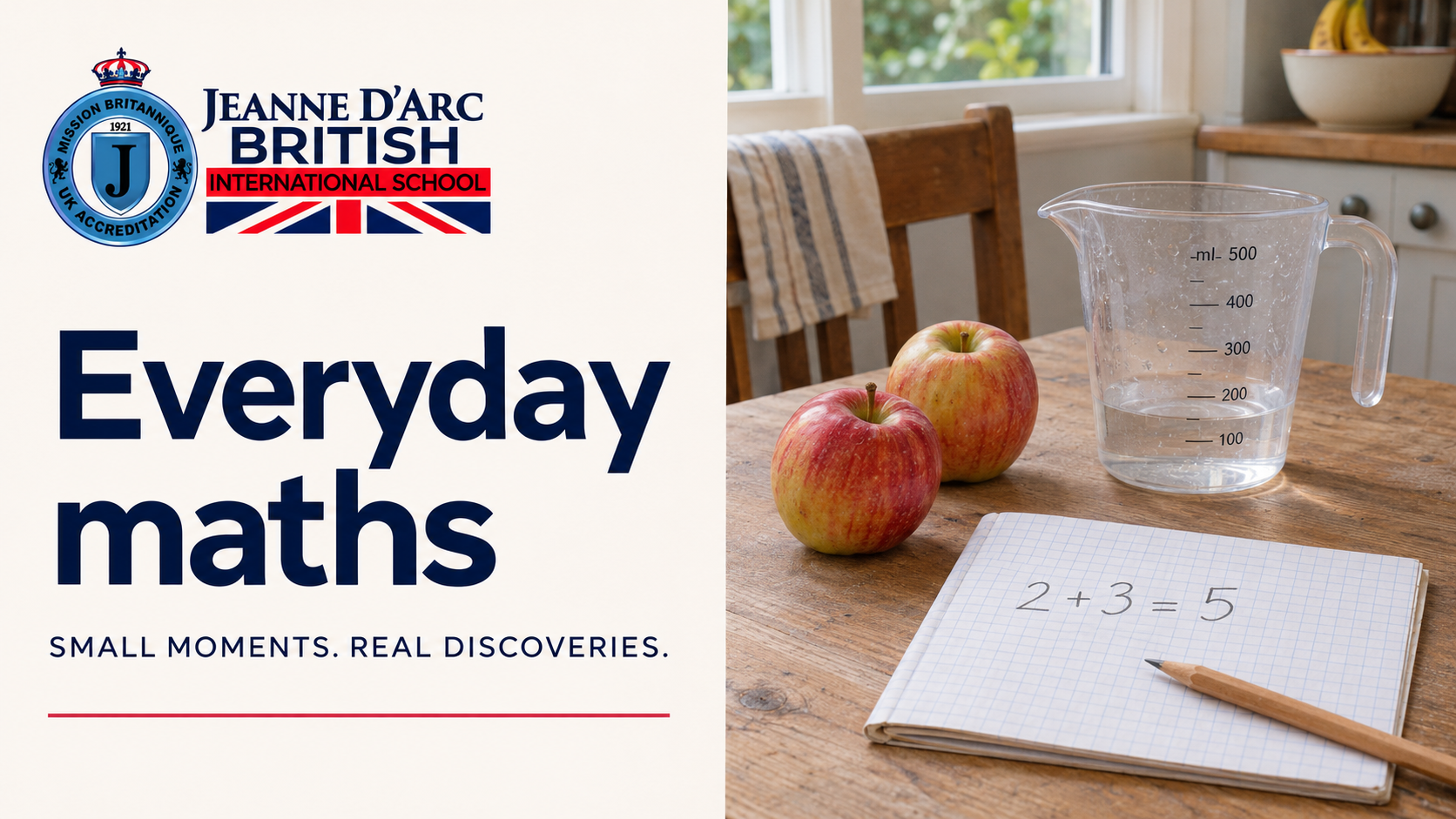
A simple recipe offers opportunities to compare amounts, read a scale or notice the order of steps. Ask which container holds more, or how you could check a measurement. Older children might discuss what changes when making half a recipe, if this fits their current learning. Choose a task with suitable adult supervision. Handling a hot pan or a sharp utensil is not necessary for joining the mathematical conversation.
Talk about prices using a small shopping list
Choose a few items and compare their displayed prices. With younger children, use pretend money or ask which of two amounts is greater. Children working on addition might estimate a total before checking it. If you use Moroccan dirhams at home, keep the examples in that familiar currency. Focus on the reasoning behind a choice rather than asking for the quickest answer.
Notice shapes, patterns and time
Look for a repeating pattern on a tile, a fabric or a row of objects. Ask your child to describe what repeats and suggest what comes next. On a familiar journey, talk about the route or compare possible departure times. Choose one question that suits your child instead of adding several calculations to every outing.
Ask how, and allow thinking time
Useful prompts include “How did you work that out?”, “Can you show me another way?” and “What could we use to check?” Let your child draw, move objects or explain in a language they know well. If an answer differs from yours, explore the steps together. When you are unsure about a school method, ask the teacher how to support it at home.
Connect the activity with school learning
Jeanne D’Arc British School describes its programme through its curriculum overview. Families can use that page as background, then ask their child’s teacher which number skills or mathematical vocabulary would be useful to practise. These activities are general suggestions for family life, rather than a statement of the school’s homework policy. Start with one manageable idea and keep the conversation open.